If taste progressed the way technology does, the past would slowly disappear. Instead it keeps coming back. After watching this pattern repeat itself enough times, it becomes clear that taste does not move linearly. It swings like a pendulum.
Movements begin as reactions to what came before them. Over time those reactions become styles of their own and eventually they overshoot. When that happens, the opposite suddenly starts to feel appealing again.
A landmark shift in taste
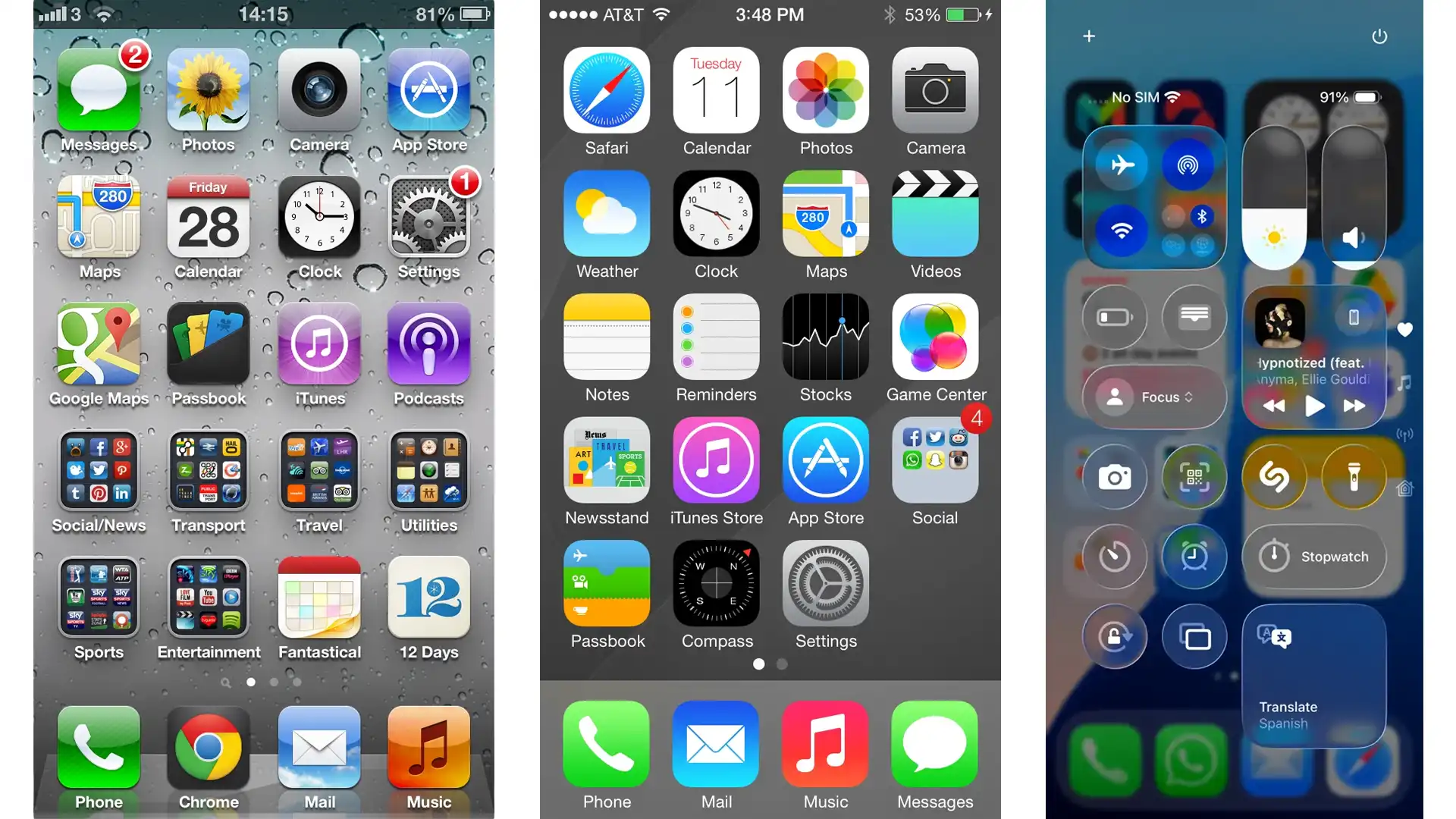
One of the most notable shifts in taste was with the release of Apple's iOS 7 in 2013. Within one single update, skeuomorphic design was completely replaced by flat design. Gone were the leather textures, shadows, and physical metaphors. That one decision (led by Jony Ive) ended up reshaping design culture for nearly a decade and within a few years, every app suddenly looked the same. Flat became the language of modern software and in turn, the language of modern life.
But now with iOS 26, Apple is introducing a new design language known as Liquid Glass. For the first time in almost a decade, there is imperfection in the design. Lighting and three dimensionality has been reintroduced. It looks almost physical - the pendulum is moving back.
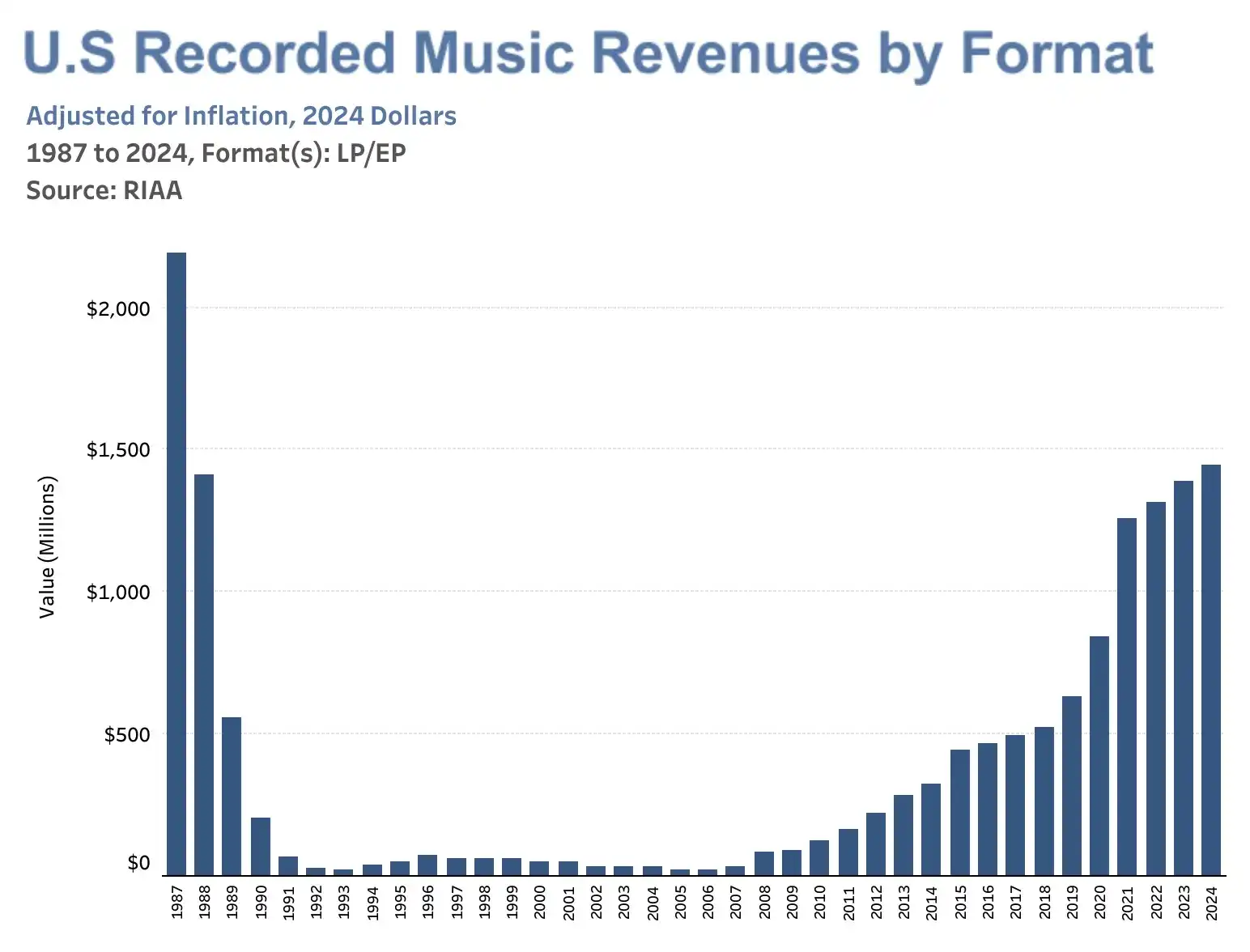
A similar transition can be seen happening outside of the digital realm. Vinyl sales have surged in recent years. In
2021, revenue from vinyl sales almost identically matched the levels seen in 1988.
[1] [2]
Vinyl had existed quietly for years until something shifted and it crossed the chasm into the mainstream market. It
moved from being a niche collectors' item to becoming one with the early majority and now everyone seems to be collecting
records. Film cameras are selling out again and baggy clothing from the early 2000s is back. The texture of older things
feels attractive again.
What makes this interesting is that it is happening at the exact moment technology is accelerating. AI has swept through
almost every industry, Waymos are popping up outside my front door [3], and we're sending TPUs to space
[4] . The world is objectively becoming increasingly automated
and digitalised and yet our tastes appear to be focused on the past.
Interest Decay
What is it that causes aesthetic movements to lose their appeal? One explanation might be something I refer to as interest decay.
When something new first appears it feels distinctive and novel. The early adopters adopt it because they genuinely like it but as more and more people follow, the thing that once signalled individuality becomes ordinary.
At that point what it signals about you changes.
Owning vinyl in 2010 signalled something different from owning vinyl in 2024. Early on it meant you were unusually interested in music but now that has become mainstream, it might appear more like participation in a trend. It's worth noting that this is not a bad thing - trends are inherently a good thing as they invoke interest in things that you may have never considered trying.
Once a taste becomes too widespread, it stops feeling cool. Not because the object itself changed, but because its signalling value changed. People start looking for the next thing that separates them from the majority which pushes the pendulum.
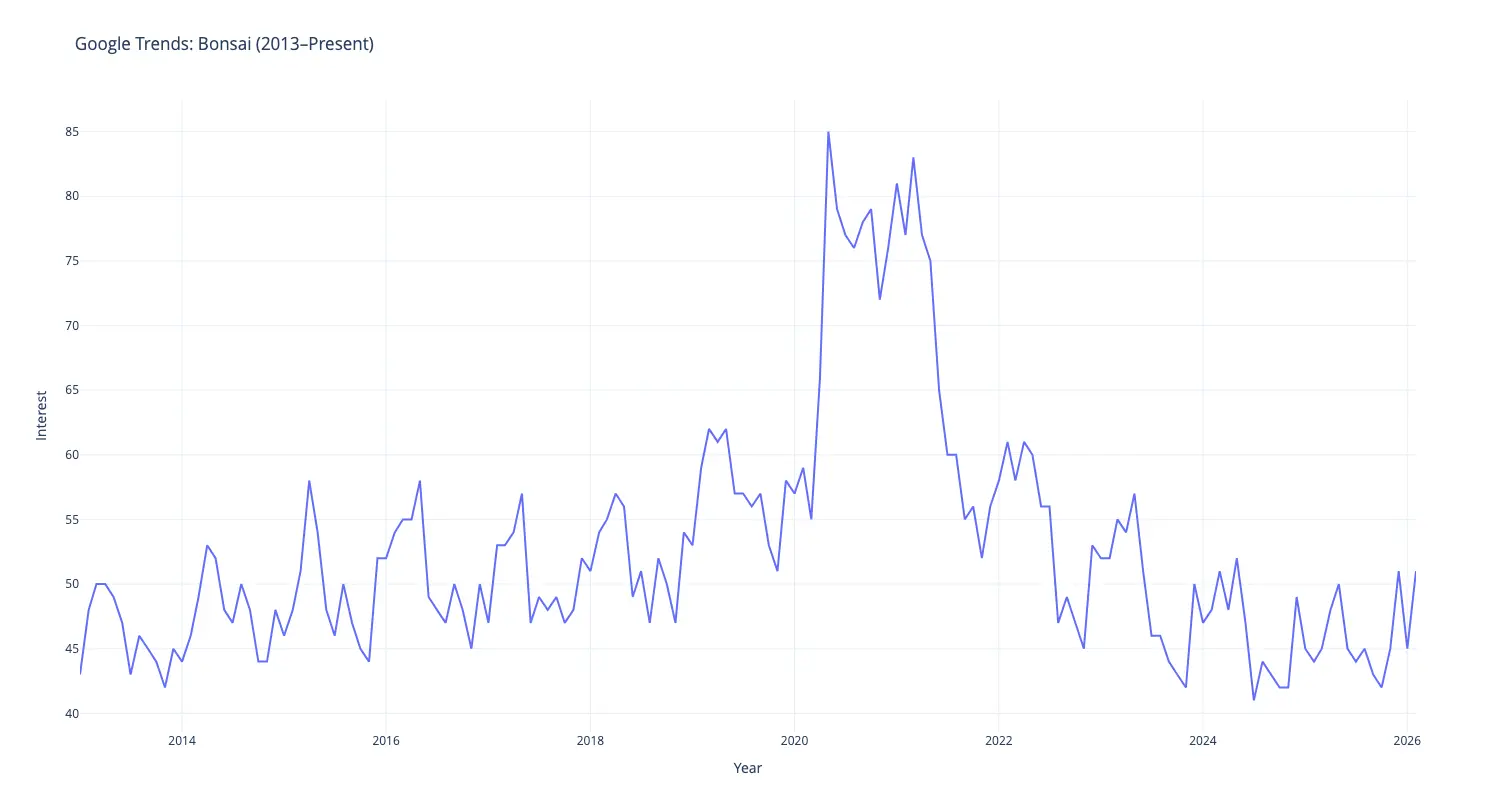
Novelty wears off faster than we expect. You can see this in small things if you look at the data. During COVID there was a huge spike in interest around bonsai trees. Everyone suddenly wanted to grow them as we were all locked in our bedrooms. Once normality started to creep back into our lives, interest dropped off again. It turns out that maintaining a bonsai tree takes a lot of time and patience that many simply do not have.
Culture behaves similarly. Aesthetic movements begin as experiments, then become dominant, and eventually become excessive. When something becomes excessive the natural reaction is to swing in the opposite direction. Once flat design began to feel sterile, imperfect brutalism became appealing. People stopped seeking out perfection and began appreciating real life for what it is: imperfect.
Timeless taste
Having a timeless taste is something practically everyone strives for. You don't want to be known as a trend hopper, you want to be known as someone who simply has good taste. But the idea of "timeless taste" is often misunderstood.
Many things that appear timeless simply survived multiple swings of the pendulum. They may have been fashionable at one point, but what makes them interesting is that they continue to feel right even when the cultural wave moves in the opposite direction. Some cultures have become especially good at preserving this kind of sensibility.
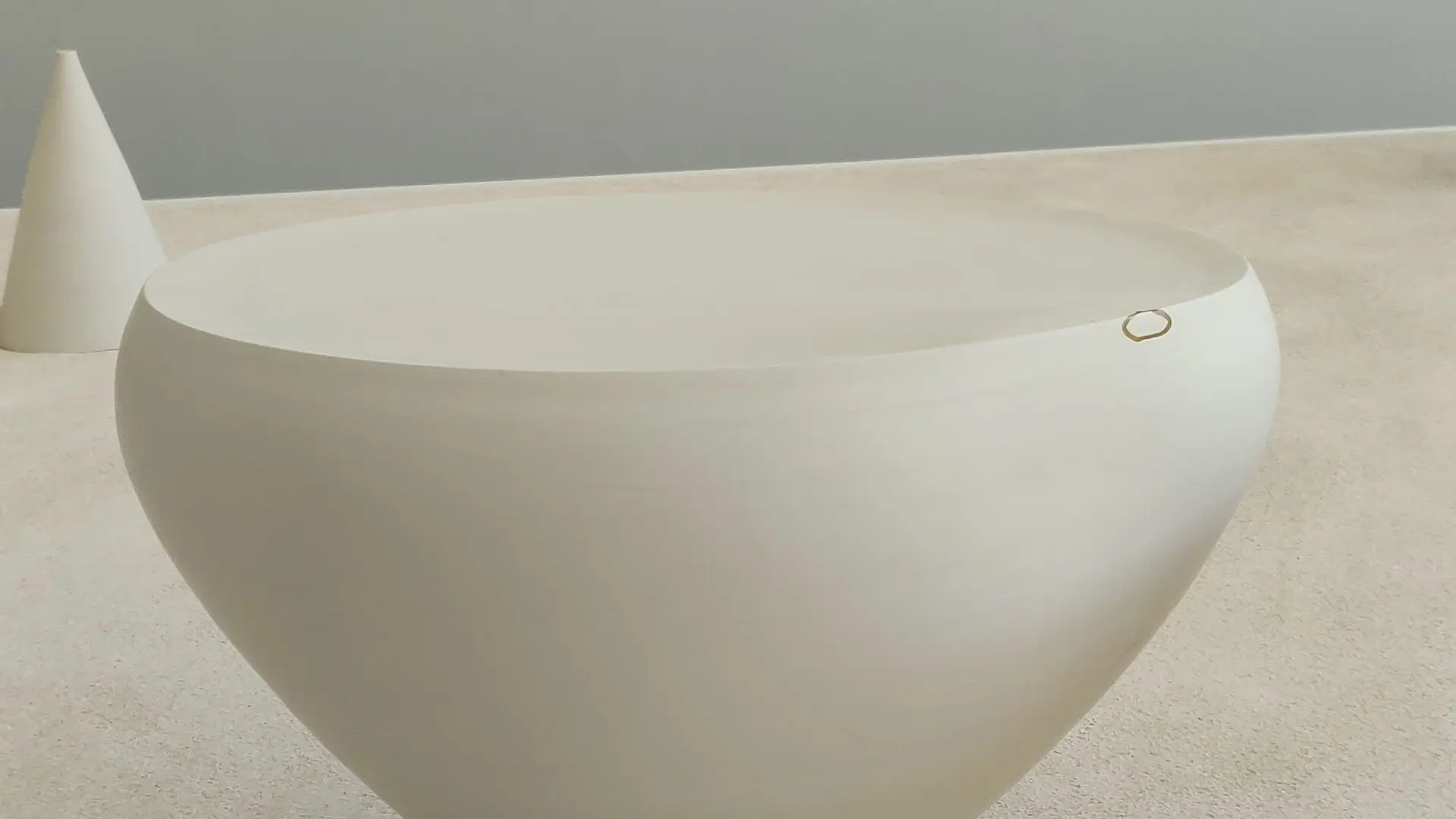
Japan is often considered a nation with excellent taste. One example of this is kintsugi (金継ぎ), the practice of repairing broken pottery with materials like gold. Instead of hiding the crack, it highlights it. The crack becomes part of the object's history rather than a flaw to be erased. This respect for the life of an object is one reason Japanese design is so admired and considered timeless.
Music follows a similar pattern. A timeless record is usually not one that perfectly fits the taste of its era. It is
one that is executed so well that it remains compelling even when the pendulum swings away from the style that produced
it (example). When a work survives
multiple aesthetic cycles, it begins to feel permanent.
Something is timeless if it still feels right after the trend that produced it has faded.
Predicting the next swing
How can you begin to see the shift in the pendulum before everyone else? This is the million dollar question that designers like Dieter Rams, Jony Ive, and Charles & Ray Eames are just so incredibly good at.
Place any of their designs into a room in the 60s, 80s, or 2026 and it'll look gorgeous. Dieter Rams famously argued that good design should avoid chasing fashion altogether. As he put it, "It avoids being fashionable and therefore never appears antiquated. Unlike fashionable design, it lasts many years - even in today's throwaway society" [5]
The designers who are able to predict cultural shifts are usually not trying to chase trends at all. They focus on solving problems clearly and honestly. Ironically, that is often what allows their work to survive long after the trends around it have faded.
In my opinion, looking at the absolute state of culture is not that useful. What matters more is the direction of change. The gradient of the curve rather than our current position on it.
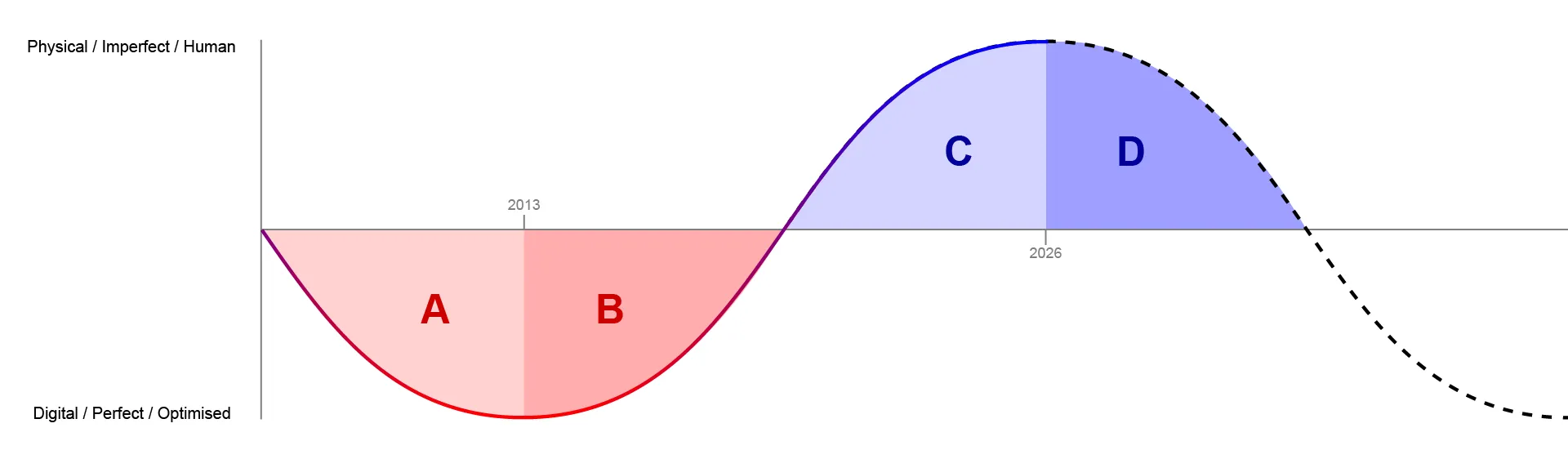
Figure A shows this sinusoidal pattern that depicts the pendulum of taste swinging between two extremes. I have split the graph into four sections as I'd like to analyse each period in what was considered to be "good" taste and what was not.
Section (A)
It's the early 2010s and we are just about to enter one of the most exciting periods in consumer technology. The iPhone 4 has just launched and people are going crazy for it. Our interfaces are dominated by skeumorphism as designers try to make our tech feel like a part of the physical world.
Styles like Frutiger Aero [6] are being tossed aside for being too cluttered and out-of-touch with the modern world. Everyone has a digital camera and vinyl had been largely forgotten for over a decade.
Section (B)
iOS 7 has released and skeumorphism is dead. Tech hipsters are running the world with the meteoric rises of Uber, Spotify, and Netflix. The whole "future is now" energy has been overdone so people are just getting used to this being the new normal.
Physical music and DVDs are in decline as streaming becomes the new norm. This is the golden era of digital maximalism. Instagram and Snapchat filters are all the rage and everyone's trying to become a YouTuber.
Section (C)
This era coincidentally aligns with COVID-19 but I think that it would've ended up in a similar situation regardless - COVID just accelerated things. People are starting to get tired of digital maximalism. Filters are cringe, being too loud is considered obnoxious, and people are far more focused on themselves and their health.
At this point people have also realised that they own nothing. Every song, movie, and video game they have ever bought is on loan to them by some large tech company. This causes a massive shift in focus from the digital to the physical. Vinyl sales begin to surge and consumer film production grows as people rediscover the appeal of owning objects rather than simply accessing them.
Section (D)
This is where we're heading next. People are going to get tired of shooting film, advancements in AI will make digital life "easier", and people will stop caring so much about things that are not important to them.
The thing that makes this era especially hard to predict is that we have a counterweight acting against people's desire for the digital realm - AI. With "AI slop" taking over social media platforms, people are becoming increasingly put off by the idea of consuming fake content. This will push people out of the digital realm and into the physical one.
I can see this being a critical moment for those trying to capitalise on the cyclical nature of taste. Right now, people's taste will naturally swing towards futurism and perfectionism (according to my theory on the pendulum of taste). But with AI, I predict that these same people will not want to experience these things through a screen, but rather in the physical world. The internet will become a playground for AI agents to interact with other AI agents and as such, humans will begin spending more time offline. Hardware design is going to become a crucial differentiator. There's a reason Jony Ive start io [7] - an artificial intelligence hardware company. He knows that this tide is about to shift.
Right now we are near the top of the retro side of the wave. When a movement reaches that level of adoption, interest
decay usually follows.
That does not mean that people's appreciation for vintage things will disappear. Movements rarely vanish completely - but the growth will slow down. People will begin to look for something else, and I predict that it will probably look futuristic again. The pendulum is going to start swinging the other way.
Closing thoughts
The strange thing about taste is that it often looks like progress while it is happening. Each new movement feels like the natural evolution of the previous one but if you zoom out, a pattern emerges. A cultural phenomenon overshoots, there is a correction, and it overshoots again. The pendulum will never stop moving and it's up to you to think about where it's heading next. That is how you maintain a good taste.
Thank you to Helen and Alex for reading drafts of this post and providing feedback.